Significant Change to Rule 59, Alabama Rules of Civil Procedure: Partial New Trials on Damages Only and Other Issues Allowed in Cases Tried to a Jury

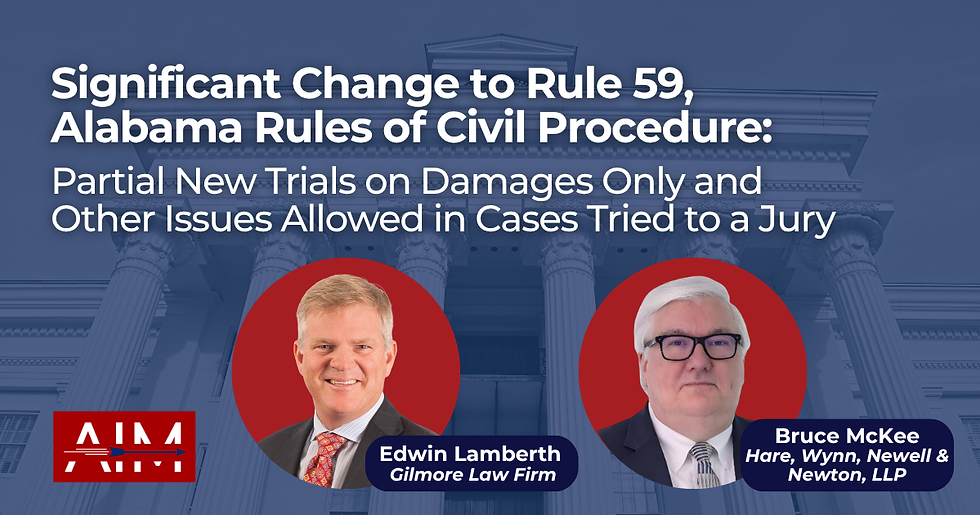
Since the adoption of the Alabama Rules of Civil Procedure in 1973, when a case was tried to a jury, but an error was made during the trial, the remedy has been a new trial on all issues tried to a jury. This Rule was inconsistent with Rule 59 of the Federal Rules of Civil Procedure, and the law in virtually all other states. No more.
Effective April 9, 2026, the Alabama Supreme Court adopted a change to Rule 59(a), Ala. R. Civ. Proc., which gives a trial court the discretion whether to retry all or part of the issues tried to a jury. For example, if a trial judge determined that a jury’s award of damages was too low, the court could order a new trial on damages only, leaving the jury’s verdict on the issue of liability intact.
The amendment does not mandate a partial retrial if the court determines that an error occurred. Instead, it authorizes the trial court to make the determination as to whether any retrial will be on all or part of the issues. The Committee Comment notes that some cases may involve issues which are so intertwined that a partial retrial is not possible. The Comment also notes, however, that when issues do intertwine, such as damages and liability, a court could allow evidence related to intertwining issues to be admitted on retrial.
Because Federal Rule 59 has long allowed partial retrials, it is advised that any practitioner facing a potential new trial on all or part of the issues should consult federal case law. Further, one should note that amended Rule 59 is not limited to partial new trials on damages. Instead, almost any issue or claim could be retried separately.
The amendment to Rule 59(a), Ala. R. Civ. Proc., adds the words “or part,” so that the first sentence of Rule 59(a) now reads (emphasis added): “A new trial may be granted to all or any of the parties and (1) on all or part of the issues in an action in which there has been a trial by jury, for any of the reasons for which new trials have heretofore been granted in actions at law in the courts of Alabama; and (2) on all or part of the issues in an action tried without a jury, for any of the reasons for which rehearings have heretofore been granted in suits in equity in the courts of Alabama.”
About the Authors

Edwin Lamberth
Gilmore Law Firm
Edwin Lamberth (B.A. University of Virginia, J.D. Cumberland School of Law) is a partner with the Gilmore Law Firm, focusing on trucking collisions, defective products, and industrial injuries. He previously served as a law clerk to Justice Champ Lyons, Jr., Alabama Supreme Court. He has been Alabama State Bar Commissioner for the past six years. He is a member of the Alabama Civil Rules Committee and has been a Board Member of the Alabama Association for Justice and has served as the Chair of its Amicus Curiae Committee for the past ten years.

Bruce McKee
Hare, Wynn, Newell & Newton, LLP
Bruce McKee (B.A., Alabama; J.D., Columbia; LL.M., Virginia) has been with Hare, Wynn, Newell & Newton, LLP, in Birmingham for over 35 years. Previously, Bruce served as a staff attorney to the Alabama Supreme Court and taught law at Jones and Cumberland. Bruce has served on the Alabama Rules of Civil Procedure Standing Committee for over 40 years. He is currently chairing a task force to update and restyle Alabama’s procedural rules.